Today is International Lesbian Day, a time to raise awareness and celebrate lesbians. But the lesbians in our community have faced danger and violence because of who they are and who they love. Being LGBTQI is still illegal in over 60 countries around the world, and even in countries where it is not illegal, lesbians are not safe. Some of these women are eventually forced to leave their homes and try and find safety in the UK.
Senzeni is one of those women. She is from Zimbabwe, where same-sex sexual activity is punished with prison and a fine. In her home country she could not live as a lesbian, she was at risk of sexual violence and murder. She escaped and came to the UK to survive. This is her story.
Senzeni's story of survival
My name is Senzeni, I am 33 years old. I am a lesbian from Zimbabwe. It’s illegal to be lesbian in Zimbabwe, when people found out I was persecuted and my life was in danger. I could not stay there; I had to choose: save my life or stay and be killed.
Ever since childhood, my life has been extremely tough. My father died when I was very young, and from when I was a small child I felt unloved by my mother – I may as well have been an orphan. My whole life I have felt like I have been cursed.
I was raped by my uncle at the age of 10, and I had to grow up with that trauma alone, without any help or support. I was a child I didn’t know what to do. At 18, I was married to an abusive man, he would beat me almost every day. We had two children, but he continued to beat me. When I was 26, he hit me with a hammer until I passed out, only waking up when I was in the hospital. That was the last straw and I divorced him.
Realising I was a lesbian
The abuse I experienced in childhood and from my husband led me to fear men. I lost feelings for them. But it wasn’t until I was 28 that I realised I was a lesbian. But I was scared. It is so dangerous to be a lesbian in Zimbabwe, I was terrified of being discovered – there is no possibility of living life openly. I did have a girlfriend, but we could never be open about our relationship; it had to be a total secret.
Being found out
I left Zimbabwe earlier in 2026 after it became impossible for me to stay there. I was attacked by a group of men as I was coming from church service on a Sunday. I don’t know how they found out I was a lesbian, but as I saw them approaching me, I could tell from their actions that they were talking about me.
When they reached me, they were throwing insults at me, they knew I was a lesbian. I tried to run away from them, but they caught up with me. There were six of them. They kidnapped me and took me to an old house and assaulted me.
Then they left me there in the middle of the night. I had to make my way home, bruised and barefoot I was barefoot. I had to tell my mother what had happened when I got home but she rejected me, she told me that homosexuality is not tolerated in her religion. I was scared to go to the police or the hospital. That night I slept outside in the bush alone because I no longer had a home or anyone to help me.
No home any more
The only person that would help me was my sister-in-law. She came to see me, but that was when I was attacked for the second time. When the attackers saw us together, they thought she was my girlfriend, and they beat us badly. I had to pretend I was dead, I lay still for a long time, not daring to move. But that meant they just concentrated on my sister-in-law. Eventually, after a long time, I was able to escape but they killed my sister-in-law.
At this point I knew I had to leave Zimbabwe to save my life. A friend put me in contact with a man who could help me get out of the country. He ran an orphanage and he had contacts that could help me leave. I had to leave my three children with him. I had no choice. I couldn’t even say goodbye to them.
Reaching the UK and finding Micro Rainbow
I am currently living in Liverpool, in a house with other women who are seeking asylum. I have been able to start attending some support groups, such as Sahir House, and meeting people. I was put into contact with Micro Rainbow by Refugee Women Connect, which I attend regularly for drop-in sessions. Micro Rainbow contacted me and share information on how they could support me.
Since then, I have been able to attend meetings online and connect with people. I have been attending Sista Sista, the LBTQI women’s group. It’s been really good. It’s a space to share our thoughts and feelings. I love it. I have also been able to go to the meditation sessions, which I really like. After the meditation session I felt relieved. I felt like my whole body was flexible, I really enjoyed it.
Trying to find a sense of safety
Now I am in the UK, I don’t feel 100% safe. But I have been able to meet and make some new friends with the groups I attend. When I am in the groups, and meeting new people, that’s where I feel safe. But alone I always have that fear, the same fears I had back home. It’s hard to let go off. I don’t know why I am scared to reveal myself.
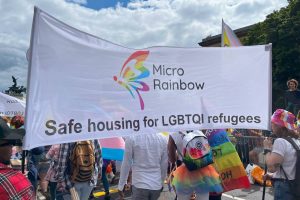
I did go to Manchester Pride to march and it was lovely. I felt like: okay, we can live openly. When you are with other people who are like you, you feel strong. I can tell myself: you don’t have to fear anything. You can just be happy. I felt so alive. I enjoyed it so much.
Moving forward
For now, I just hope that I can get my status, get settled and start living my life happily and openly. I want to make a home here. I love Zimbabwe – but it doesn’t love me back. I try and forget about home, and concentrate on building a new life here. I want to get to a stage where I am not scared any more, not in fear of people harming me. I want to finish my education and then help other LGBTQI people who have been forced to leave their countries. I can relate and empathise and I want to be someone who can support other people through this, to help them on their journey.