
In 2024, there were 350 reported deaths of transgender people as a result of anti-trans hate, with the largest affected demographic being black and brown trans women. In the face of these bleak statistics, community and allyship grow increasingly important. Setting aside time and space to reflect, mourn, process, heal, connect and honour those lost is paramount.
What is Transgender Day of Remembrance?
Gwendolyn Ann Smith founded Transgender Day of Remembrance (TDOR) following the death of her friend Rita Hester, a black trans woman who was murdered in Boston in 1998. In her own home – somewhere she was supposed to feel and be safe – Rita was attacked because of her identity. Too many lives had been lost, and, like in Rita’s case, too many crimes had not received the effort they deserved to be solved merely due to intolerance. To reflect this, TDOR sets out to call attention to the lives lost.
Having a designated day to hold vigils in remembrance of those lost to transphobic violence is critical in the fight to mitigate the consequences of hate crimes. Reflecting upon the cost of intolerance honours the dead by helping guarantee that their stories continue being told and they are never forgotten. Further, it brings much-needed global attention to the continual struggles of the trans community. In doing so, LGBTQI people are given a channel to support one another while allies can educate themselves on how they can help.
Trans people seeking asylum
14 countries criminalise the gender identity and/or expression of transgender people, and in many more countries, transgender people are persecuted and socially ostracised.
Testimonies from past trans asylum seekers Micro Rainbow has worked with have offered insight into the trans asylum-seeking experience. In their home countries, they often face discrimination, violence, and hatred. Many are rejected and cast out by their families. Others have to hide their true identity and live a lie in order to survive. Bianca, a trans asylum-seeker from Guyana, once told Micro Rainbow:
“During my life in Guyana, I was constantly harassed for being LGBTQI. I was beaten many times. I always had to watch my back, and I was even once stabbed in the back as I was walking along the road. It is impossible to live openly and safely in that country. I could not secure work, I could not get medical care. The staff in hospitals would openly mock me, they would call me Auntie Man. It was hell.”
Even upon arrival in the UK, trans people seeking asylum still don’t have it easy. They often get deadnamed by the Home Office and in their documentation, struggle to access key medical care, including hormone therapy, and face continued transphobia in both asylum-seeker housing and the broader UK. They are more likely to face severe isolation, fear, discrimination, homelessness, and poverty.
This means that days like TDOR are essential because they move society towards greater understanding and acceptance through education and empathy.
Support
Micro Rainbow’s mission is built on three primary tenets: safe housing, social inclusion, and moving on.
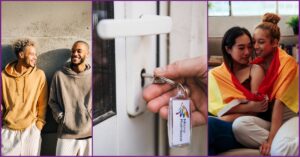
Micro Rainbow’s safe housing programme provides safe and secure housing in which LGBTQI people fleeing persecution can live authentically without fearing for their safety or facing judgment based on their identity. The social inclusion programme aims to reduce the isolation and loneliness our community. We do this by frequently hosting both in-person and virtual events that foster community and belonging – including projects like Trans Zine of Knowledge – which is specifically for trans people.
Finally, the moving on process aims to help beneficiaries integrate into society and rebuild their lives after being granted asylum. This extends to all possible areas, including accessing education, occupational opportunities, achieving financial stability, and much more.
Alexis, a trans woman from Nigeria who lived in our housing in the West Midlands, said the following about her experiences with Micro Rainbow:
“Firstly, I would like to appreciate Micro Rainbow for coming through for me when I needed help.
At first I thought it will take a long time for me to be move[d] out of the hotel where I was after I was told I will be on a waiting list. But to my surprise, I was called one day that they have a house in Birmingham which I didn’t hesitate to accept. …the person who contacted me told me not to worry that everything will be fine and if I need to talk, I can always reach out to her. That word alone give me peace. The day I finally got the letter, I was so excited to leave… Coming to Micro Rainbow hous[ing] changed my life. Connecting me to resources, being around the community changed my whole life. It felt like I was as free as a butterfly.
I like the fact that Micro Rainbow look after the people they support. This is something I never get to experience back home in my country as a Transgender woman. There’s nothing I dislike about Micro Rainbow because I have received more support than I expected.
As a Transgender woman, Micro Rainbow has positively impacted my life. Through Micro Rainbow, I have built my self-confidence. Micro Rainbow has made me understand that who I am is valid and my feelings are valid.
Words alone cannot express how I feel about the support I have received from the first day I contacted Micro Rainbow but all I can say is I have received enough support than I expected and I’m forever grateful.
[THE] MICRO RAINBOW COMMUNITY IS A PLACE TO BE.”
Written by Julia Hamdi